

The Extend letters and Sounds programme has enabled all pupils to access the world of reading. Our pupils have achieved above national for 3 years in the year 1 phonics screening assessment and we do not disapply any child.
This program supports pupils to keep up, in particular our SEND pupils make rapid progress using the phonics programme and the quick fire phonics interventions. Over 50% of pupils enter year 2 as free readers, no longer needing a step decodable book.
The program allows staff to ensure that all provision is triangulated so a child is given sentences to write that match their phonetic knowledge meaning it is inclusive at it's very core.
Locking Primary School December 2025
Extend Letters and Sounds is really beneficial for all children, especially disadvantaged and SEND pupils due to its repetition, and familiar structure, that allows the children to copy adult's modelling. Children always hear clear modelling of blending before attempting independently, to ensure success, and mistakes are not allowed to be rehearsed.
Mead Vale Primary School December 2025
Extend Letters and Sounds
Extend Letters and Sounds: a complete programme for the teaching of early reading and writing combines a systematic, synthetic phonics programme with strategies to support children’s development of reading comprehension, handwriting and compositional skills. It is inclusive by design and promotes a lifelong love and appreciation of reading and writing.
The rationale behind the Extend Letters and Sounds – a complete curriculum for phonics, early reading and writing is clear: our curriculum and our teaching should ensure that children ‘keep up, not catch up’. This is easy to say but is particularly challenging for some of our most disadvantaged children and children with special educational needs.
Extend Letters and Sounds is a programme that addresses the needs of all children so ‘every individual child’ has an equal chance of success.
Progressions
Extend Letters and Sounds (Extend) has broadly adopted the DfE Letters and Sounds order for grapheme introduction that enables children to read and spell words by the end of the first week of Step 2. The Extend Programme moves from simple to more complex phonic knowledge and skills.
The programme begins with a focus on the development of children’s phonological and phonemic skills to ensure they have the best chance of reading and writing success.
The skills of blending and segmenting are taught from the very beginning when children learn how to orally blend and segment. Children then apply these skills to read and spell simple monosyllabic words before moving onto to reading and spelling more complex polysyllabic words.
By the end of Year 1, all major grapheme/phoneme correspondences have been covered. The Extend Programme has been cross-referenced with the DfE Letters and Sounds, the national curriculum 2014 and the EYFS Framework 2025.
Guidance for teachers
The programme manual provides guidance on how to teach phonics, early reading and writing and includes a term by term overview setting out how teaching and provision evolves over time.
There is guidance to support practitioners to plan for the twelve aspects of phonological and phonemic awareness and physical development required for handwriting including some activities that are required of all pupils.
Phonics is taught daily. All lessons are fully-resourced and include scripts and presentations to support delivery. The programme also includes exemplar planning, resources and scripts for instructional reading and writing sessions.
Resources
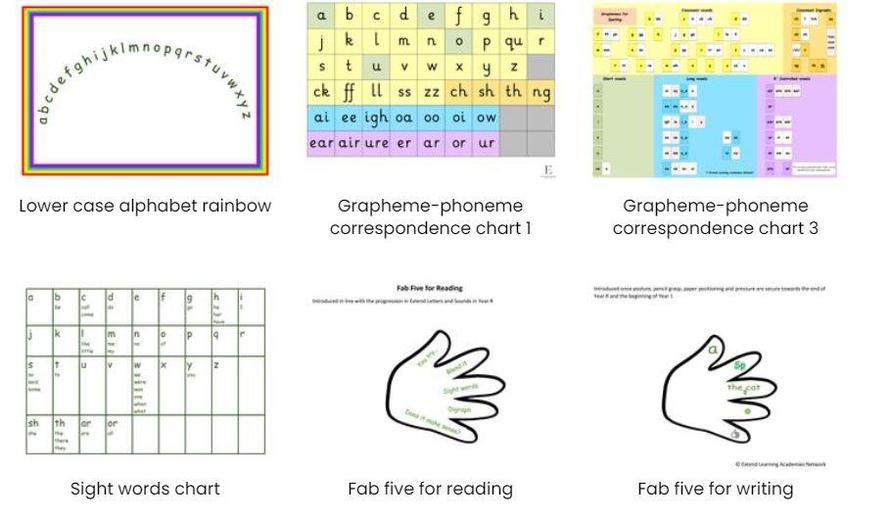
The programme comes with carefully designed pupil resources including:
· Upper and lower case alphabet rainbows used when children are learning letter names.
· Grapheme-phoneme correspondence charts that match the programme progression.
· Sight words charts covering the common exception words.
· Fab five for reading - a visual of the reading prompts for decoding.
· Fab five for writing - a visual that supports children and adults to critique transcriptional skills.
· Learning resources for writing - a ‘one-stop shop’ resource for children when they are writing.
Children will also need:
· an individual magnetic whiteboard with a frame (minimum size A4)
· upper and lower case magnetic letters
· lined A4 whiteboard (with a margin)
· fine-tip whiteboard pen
· whiteboard rubber.
Decodable reading material
The Extend Letters and Sounds Programme has been aligned with the Big Cat Phonics for Letters and Sounds reading scheme and teachers can easily find books that match the step they need by referencing the Extend Letters and Sounds decodable reading books catalogue.
Assessment
The Extend Letters and Sounds Programme is underpinned by a clear rationale that children should ‘keep up, not catch up’. Therefore, the programme sees that on-going in-class assessment and periodic summative assessment are essential.
Each lesson script describes in-class assessment opportunities. The guidance indicates that, whenever possible, feedback should be given within the lesson. However, teachers may also wish to respond through precision teaching.
Detailed assessments are carried out at the end of each step. These assessments cover all new learning within that step so that the information can be used diagnostically. Pupil outcomes are recorded on individual pupil record sheets. This data is entered onto a cohort record sheet which automatically calculates percentages of pupils who are considered to be on track.
"Leaders ensure that pupils learn to read as soon as they start school. They check that staff teach the curriculum as planned. As a result, pupils remember the sounds they have learned successfully. To support this, pupils read books that are matched to the sounds they know. Teachers use what they know about pupils to provide extra support with reading where needed, including for pupils with special educational needs and/or disabilities (SEND). Staff read to pupils regularly and develop their understanding of a range of vocabulary. Pupils choose from high-quality texts and read for pleasure. In Reception, staff ensure that books are readily available for children to read." Milton Park Primary School, Ofsted January 2022
"There is a whole-school culture of prioritising reading. The teaching of early reading is well organised. Staff are trained well so that they know how to teach phonics effectively. Children learn phonics right from the start of their time in school. There is a clear and consistent structure to the teaching of phonics. When pupils fall behind, staff identify what further input is needed and provide support to enable pupils to keep up. Leaders make sure that the resources they use enhance the teaching of phonics." Oldmixon Primary School, Ofsted 2022
Cost
The programme is purchased in the first year with a package of professional development to support implementation. Once the programme has been purchased annual subscription to access the materials is not required. However, a bespoke programme of professional development is available to ensure that implementation is embedded.
Year one costs (per school)
|
Programme |
£550 |
|
Professional development package |
£2,555 |
|
Total cost for year one |
£3,150 |
Note: the programme cannot be purchased without the first year of professional development. However, there is no requirement for an annual subscription.
Year two costs (per school)
On-going professional development is essential if the programme is to be embedded and sustained. Each year trainers will review professional development needs with the school to create a bespoke package of support.
Costs will range from £780 to £1,515 per annum. There is a discount available for schools with fewer than 110 pupils.
To see the full breakdown of costs please contact Caroline in the Education Team on 01934 313390 if you have any questions.
At Home
Parents and carers can get involved, too! The programme provides free advice and guidance on supporting children with their reading and writing at home.